
How to Search Criminal Dockets
Start with the official Burnet Odyssey Public Access link. The county provides the visitor credentials shown on that login page. The portal is a starting point, not a promise that every court, field, filing image, or restricted case will appear. The post-login search controls could not be verified during the county research because the host later returned an access error.
Have the exact party name, cause number, and likely court ready. A felony usually belongs with the District Clerk, while a County Court at Law misdemeanor is routed through the County Clerk. A sheriff or state-trooper Class C citation generally belongs to the issuing Justice Court precinct. A city-police citation stays with that city court.
Online access is only one channel. The District Clerk accepts record questions at its Annex North office and by phone. County Court at Law files can be traced through the County Clerk and court office. Justice Court and municipal clerks can explain their own docket, mail-request, counter, and copy procedures. A written request should give enough detail to locate the case without sending sensitive identifiers that the office did not ask for.
- Open the county Odyssey page and use the published visitor login.
- Search with the exact name or cause number shown on a notice.
- Match the court, case type, and filing details before relying on a result.
- Read charges, settings, pleas, and disposition as separate fields.
- Ask the responsible clerk for missing records or a certified copy.
Burnet Criminal Docket Search Limits
Odyssey's public login carries a county disclaimer about accuracy, reliability, and completeness. A name match should be checked against the court, cause number, and case type. The official interface did not permit verification of advanced filters during research, so users should not expect a date, status, charge, or document filter until the live portal shows one.
When a precise field is unavailable, narrow the request with the filing court and date range, then ask the clerk to confirm the public record. Do not substitute a commercial people-search result for an official Burnet County docket.
Burnet Criminal Dockets Start with Clerk
The Burnet County District Clerk maintains felony, some misdemeanor, and grand-jury records. Its criminal counter is in Courthouse Annex North, Suite 90, 1701 E. Polk Street, Burnet, and the listed phone is 512-756-5450. The 33rd and 424th Judicial District Courts share district administration but keep a case tied to its assigned court and filing county.
Use the District Clerk when Odyssey fails, when a certified result is needed, or when the public view does not show an expected event. In-person, telephone, and clerk-assisted copy requests remain practical access routes. An indictment, bond entry, or arraignment proves only that a procedural step occurred. None is a conviction.
The official Burnet County criminal procedure page also helps route Justice Court matters. Keep those fine-only cases separate from district felony files.
For a statewide cross-check, re:SearchTX can expose public data from participating Texas courts. It does not replace the Burnet County clerk, and eFileTexas serves a different purpose. E-filing transmits documents and tracks a filer's submission. It is not a public docket search or a source of certified copies.
What a Criminal Docket Shows
A Burnet County criminal docket is a running event history, not the full case file. It may identify the court, cause number, charge, filing date, parties, counsel, settings, motions, orders, plea, and disposition. A posted municipal list can be much narrower. Burnet's official municipal sample used separate citation, docket, charge-code, and charge-description fields, which should not be assumed to match Odyssey.
| Cause Number | The court's exact identifier, such as court-assigned cause number; preserve all punctuation. |
|---|---|
| Charge | The alleged offense and, when public, its degree or statute reference. |
| Setting | An arraignment, status, announce-ready, plea, or trial date, not a result. |
| Plea | A separately recorded response such as guilty, not guilty, or no contest. |
| Disposition | The recorded outcome, which must not be inferred from a hearing label. |
Burnet Criminal Docket Terms
The March 10, 2023 County Court at Law memo gives “announce-ready” a precise local role. It describes that setting as the last day for a plea bargain before the case moves toward trial. Dispositive motions, including a motion to suppress, must be written, served, and set before announce-ready under the memo.
- Arraignment
- An early setting where the charge and plea or rights process may be addressed.
- Status setting
- A progress checkpoint before announce-ready or a plea docket.
- Announce-ready
- The local memo's cutoff setting for a plea bargain before trial progression.
- Disposition
- The recorded outcome, distinct from any of these settings.
Because the memo is dated, confirm current practice with the County Court at Law office. Its value is as a published map of local docket terms, not a permanent promise that no later order has changed the sequence.
Burnet Criminal Docket Payment Warning
The Justice Court materials warn that an online payment can operate as a no-contest plea, waive trial, and produce a conviction. Payment is therefore not a neutral way to check whether a case exists. Read the citation and court options before submitting funds. The same county material points to payment plans, community service, and inability-to-pay procedures, but only the assigned court can apply them to a case.
Defensive-driving requests also have timing and eligibility rules. A payment made first may change the available path. Ask the precinct clerk before acting when the docket shows a balance but not the full procedural choice.
Stages on a Criminal Docket
Burnet County criminal cases do not all move on one track. The 2023 misdemeanor memo lists arraignment, status settings, announce-ready or plea docket, and trial for many newer matters. It shortens the setting sequence for older cases, including a distinct track for cases above the memo's 250-day threshold. A felony record may instead show grand-jury and indictment events before district settings.
Docket flow: Charge Filed › Arraignment › Status Settings › Announce-Ready or Plea › Trial › Disposition
Each label answers a different question. “Filed” means an item reached the clerk. “Set” means the court placed an event on a schedule. “Heard” means a proceeding occurred. “Signed” refers to an order. Only the actual judgment or disposition field establishes the result.
The county's public calendar can add schedule context. Labels such as Misdemeanor Docket, Arraignment Docket, and Misdemeanor AR Docket identify court sessions, not complete party-by-party histories. Follow the event's details link, then compare it with the case docket and the latest notice from the court. A calendar entry can change without resolving the criminal case.
Burnet Criminal Docket Continuances
For a Justice Court criminal setting, the county says a continuance request must be written and delivered to the Justice Court office at least three days before the court date. The request is not the reset itself. Check the docket, court notice, or clerk response to confirm whether the judge granted it and what date now controls.
Do not assume a date moved. Missing court can lead to added process or a warrant. Contact the assigned precinct clerk when the record and notice conflict.
Municipal and County Court at Law cases use their own rules. The county calendar, an Odyssey event, a mailed or electronic notice, and a signed order may show different stages of a change. Compare them and ask the court which entry governs.
Burnet Criminal Docket Security Planning
The Burnet County court-security page explains that people and property entering county court facilities are subject to screening and that weapons are prohibited. Arrive early enough for that process. A docket time is the time set by the court, not the time to begin parking or screening.
Confirm the building before leaving. District cases are commonly handled at Annex North, while County Court at Law and several county functions use the courthouse. A municipal or Justice Court case may be elsewhere.
Which Court Holds Criminal Dockets
Felonies and grand-jury matters point to the District Clerk and the 33rd or 424th District Court. County Court at Law misdemeanor matters generally point to the County Clerk and that court's office. Fine-only criminal and traffic cases filed by county or state officers go to one of four Justice Courts. City ordinance and Class C cases filed by city police belong to the relevant municipal court.
| Case layer | Likely record office | Search route |
|---|---|---|
| Felony | District Clerk | Odyssey, clerk counter, phone, or copy request |
| County misdemeanor | County Clerk / CCAL | Odyssey, county calendar, or clerk |
| Class C / traffic | Issuing JP precinct | Precinct clerk and court docket |
| City Class C | Municipal court clerk | City court portal, phone, mail, or counter |
The Magistrate court list helps identify the local court network, but the jail or magistrate office is not a substitute for each clerk's case file.
Routing matters because the clerks hold different records. The District Clerk is in Annex North. The County Clerk and County Court at Law use the courthouse at 220 S. Pierce Street. Justice Court precincts have their own clerks, including offices in Burnet and Marble Falls. Call the office named on the citation or notice before traveling, especially when the issuing agency or precinct is unclear.
Burnet Criminal Docket Portal Errors
An access-denied screen, empty search, or missing event is not a finding about the case. The cause may be a wrong court, spelling variation, indexing lag, restricted access, or a portal outage. Try re:SearchTX for participating Texas courts, but do not assume statewide coverage is complete.
Then contact the responsible Burnet County clerk. Give the name, cause number, court, and approximate filing date. Ask whether the item is unfiled, unindexed, not scanned, sealed, expunged, restricted, or held elsewhere. In-person inspection, a mailed request, telephone guidance, and a clerk-produced ordinary or certified copy are all documented alternatives to the database.
The official Burnet Municipal Court page is the correct city route for its cases. Other cities have separate systems.
Public Access and Sealed Criminal Dockets
Public access does not mean every document or field is open. A docket may confirm a filing or hearing while an attachment remains sealed, redacted, or confidential. Juvenile files, expunged records, protected addresses, and sensitive personal data have distinct rules. Nondisclosure, deferred adjudication, and expunction are also different statuses.
Key Rules:
Texas Family Code Chapter 58 restricts inspection and copying of juvenile records.
Texas Code of Criminal Procedure Chapter 55A governs expunction.
Texas Rule of Judicial Administration 12 governs judicial administrative records, not ordinary access to every case file.
Burnet Criminal Docket Procedure Route
The county's official criminal court procedure page shows how Justice Court matters differ from the higher criminal courts.
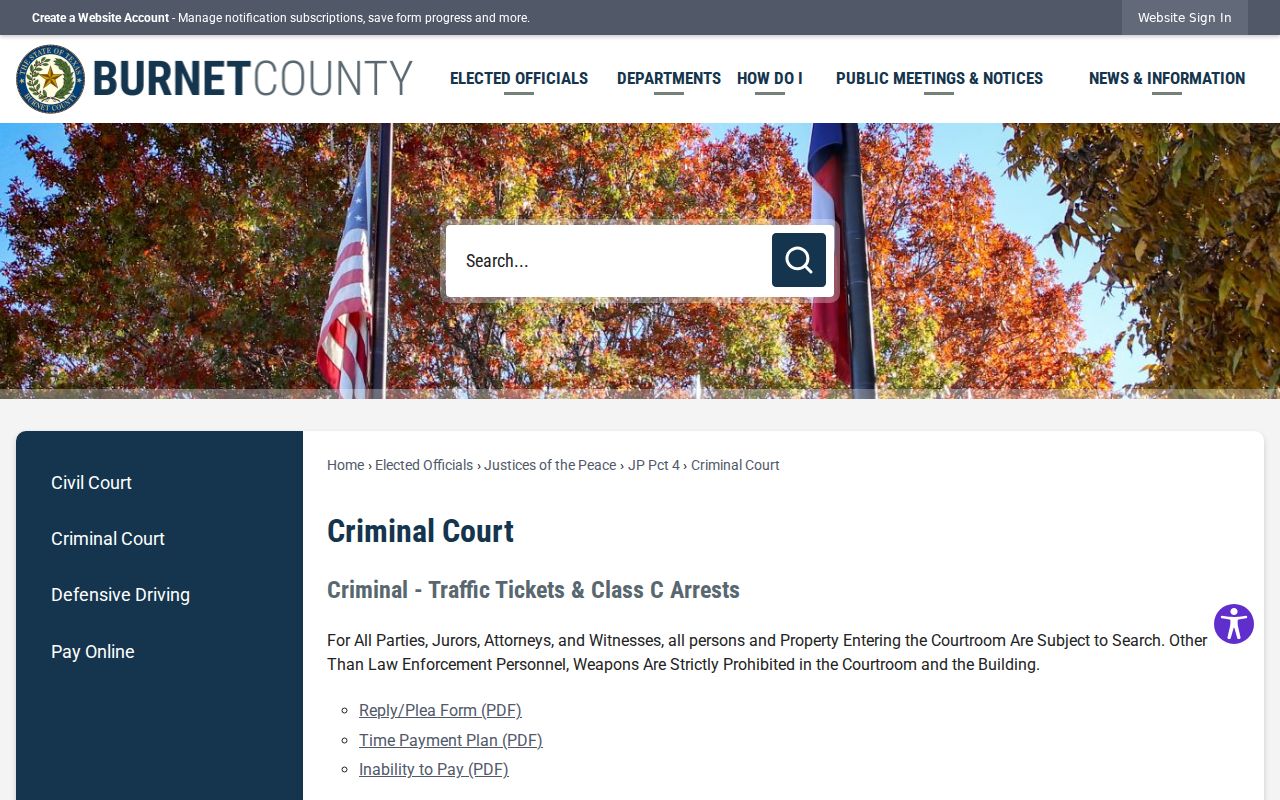
The page is useful for courtroom conduct, trial choices, appeal timing, payment alternatives, and the written continuance rule. It should be read with the actual citation and precinct notice because it is not a full case docket.